
Measuring AI ROI: A Practical Guide for B2B Teams in Spain
Learn how to measure AI ROI: set a baseline, count the right costs and benefits, use a simple formula, and review results on a schedule that suits Spanish firms.

To measure AI ROI, pick one process, record how it performs today, count every cost of the AI project, and compare the same numbers after launch. The result is net benefit divided by total cost, reviewed at fixed intervals. Most companies skip the first step, and that is why most cannot show a return. A 2026 survey of Spanish executives found that 87.2% say their companies use AI agents, yet only 12.8% have detected tangible revenue increases.
This guide walks through the method we use with founders and operations leaders at B2B companies: define the outcome, set the baseline, build the cost side, choose metrics, attribute the change, and keep tracking.
TL;DR
- AI ROI is net benefit (savings, extra revenue, avoided costs) minus total cost, divided by total cost. Measure it per process, not per tool.
- Take a baseline before launch. Without a “before” number, no “after” number proves anything.
- Count three returns separately (operational, commercial, strategic) and include the cost of the hires you did not have to make.
- Judge first-year ROI with caution: benefits often build over time, so review at 30, 90 and 365 days and look at a multi-year horizon.
- Redesigning the workflow around AI matters more than handing out licenses.
Table of Contents
- What AI ROI actually means
- Step 1: Set a baseline before anything goes live
- Step 2: Build the full cost side
- Step 3: Count three kinds of return, then the cost you avoided
- Step 4: Choose metrics that match the use case
- Step 5: The formula and the payback period
- Step 6: Attribute the change to AI and handle what is hard to quantify
- How often to measure, and what to report
- Five mistakes that distort AI ROI
- Our perspective
- Put a baseline and a target on your next AI project
- FAQ
- Sources
What AI ROI actually means
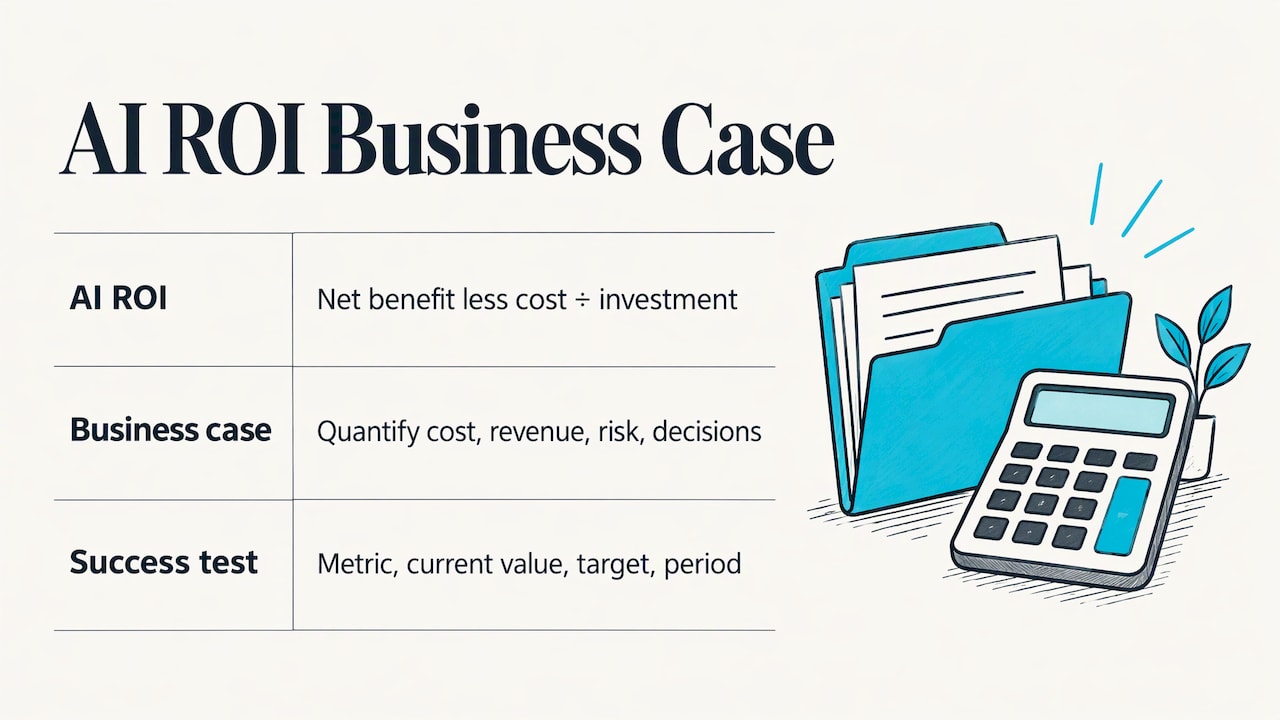
AI ROI is the net benefit of an AI initiative relative to what it cost. ENTIA, a Spanish AI consultancy blog, defines it as net benefits (savings, additional revenue, improvements) minus costs (implementation, maintenance, training), divided by the investment. For Spanish SMEs it adds qualitative gains such as fewer errors, better decisions and alignment with rules like the EU AI Act.
The definition is easy. The hard part is deciding in advance what “benefit” means for your company. SAP’s Spain guide recommends building a solid business case before implementing any AI technology: move from general ideas about efficiency to quantifying impact across cost optimization, revenue growth, risk mitigation and decision quality. It also advises modeling ROI through specific, high-value use cases and taking a multi-year view.
In practice, write one sentence before you start: “This project is successful if [metric] moves from [current value] to [target value] within [period].” If you cannot fill in the brackets, you are not ready to buy or build anything yet.
Why the question matters now
Adoption is high and proof of return is low. McKinsey’s 2026 State of AI report, as reported by Europa Press, found that 80% of employees report productivity gains from AI, but only 37% of companies report a positive EBIT impact. Only 6% of organizations qualify as high performers, meaning AI contributes at least 5% of their EBIT.
PwC’s 2026 CEO Survey tells a similar story. According to Forbes’ coverage, 56% of CEOs saw neither higher revenue nor lower costs from AI in the last 12 months, and only 12% saw both. CEOs who report returns were two to three times more likely to have embedded AI extensively across decision-making and demand generation. Value comes from redesigned workflows, not from distributing licenses.
The lesson for a 10-to-500-person B2B company: individual time savings are real but do not automatically reach the P&L. You have to design the project so they do.
Step 1: Set a baseline before anything goes live
The most common reason an AI project “cannot prove it worked” is that nobody recorded how the process ran beforehand. Do this before the first prompt, integration or agent goes into production.
- Pick one process. Invoice handling, first response to support tickets, lead qualification, quote preparation. One process, one owner.
- Time it. Record the average and the range of minutes per unit (per invoice, per ticket, per lead). Use two to four weeks of real data, not an estimate from memory.
- Count the volume. Units per week or month. Seasonal peaks matter.
- Record quality. Error rate, rework rate, customer complaints, missed follow-ups.
- Cost the people time. Use the fully loaded hourly cost: salary plus employer social security contributions, not just gross pay.
- Record the outcome metric. For sales, that might be meetings booked per 100 contacts or days from inquiry to proposal. For operations, order cycle time.
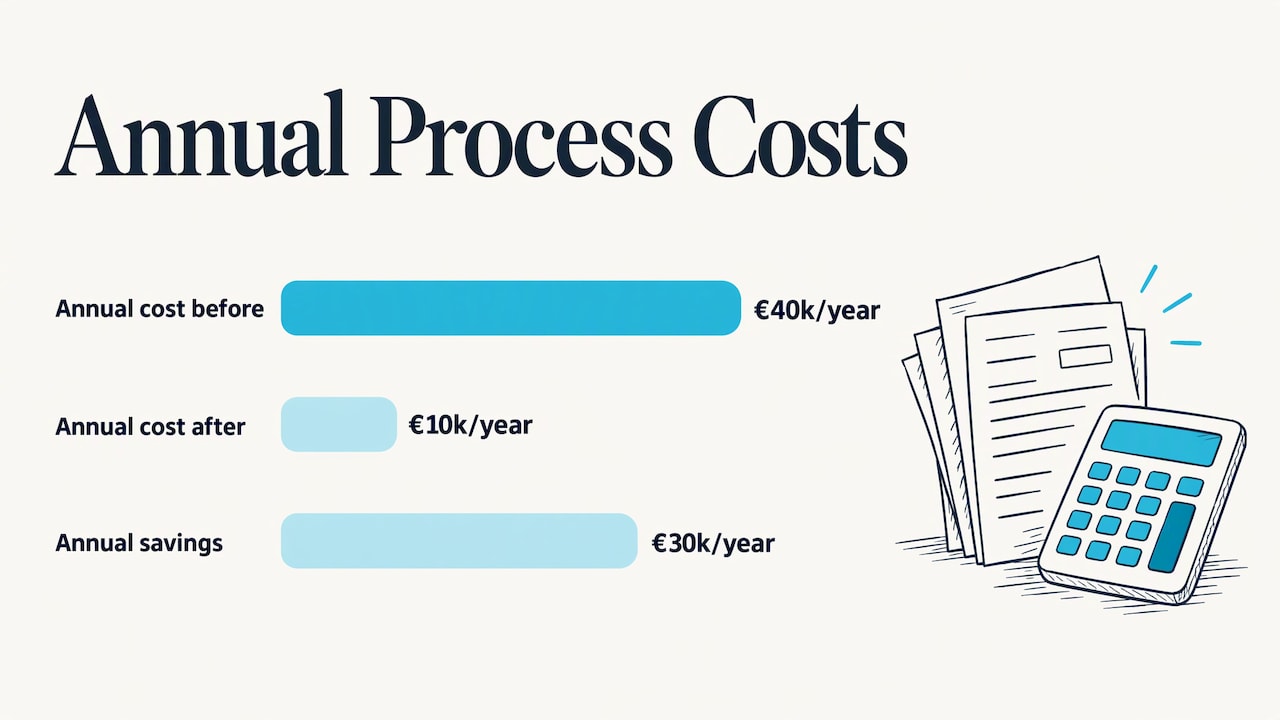
A worked example with invented round numbers, for illustration only: a finance team processes 400 supplier invoices a month at 20 minutes each, which is about 133 hours. At a loaded cost of €25 per hour, that is roughly €3,333 a month, or €40,000 a year. That figure is your baseline cost. If an automated flow brings the average to 5 minutes, you can calculate the saving from measured data rather than from a vendor’s promise.
Step 2: Build the full cost side
Cost is where optimistic business cases leak. Include every line, in the first year and in the following ones:
- Build or setup: consulting, development, integration with your ERP or CRM, data cleanup.
- Licenses and usage: software subscriptions, model API consumption, cloud hosting. Usage-based fees grow with volume, so project them.
- Training and change management: hours your team spends learning the new flow, which are real salary cost.
- Maintenance and monitoring: prompt and model updates, exception handling, someone who owns the system.
- Compliance: review against the EU AI Act where the use case touches regulated areas, and data protection checks.
For scale, one Spanish aggregator estimates that a simple AI setup for a micro-SME of 5 to 20 employees can cost between €1,000 and €4,500 in the first year, covering initial tooling, expansion and consolidation. Treat that as an order of magnitude for off-the-shelf tooling, not a quote for a custom integration with your systems.
Step 3: Count three kinds of return, then the cost you avoided
Revista Negocios, writing about Spanish SMEs, identifies three types of return and says each should be measured separately before they are consolidated:
| Return | What it covers | Example metrics |
|---|---|---|
| Operational | Efficiency gained | Hours saved, cycle time, automation rate, error rate |
| Commercial | Impact on sales and revenue | Qualified leads, meetings booked, conversion rate, average deal value |
| Strategic | Advantages that are hard to quantify but observable | Response speed, perceived quality, ability to scale without hiring |
The same source adds a fourth block that many teams forget: the cost of not scaling. If, without AI, you would have needed two more people, then their salaries, social security, office space and onboarding belong in the return. This matters most for growing B2B companies, where the real alternative to automation is often a hire, not the status quo.
Keep the three returns in separate columns of your spreadsheet. Merging them early hides which type of return is carrying the project and which is still unproven.
Step 4: Choose metrics that match the use case
Metrics should come from the process, not from the tool dashboard. Usage numbers (logins, prompts, messages) say people are using AI. They do not say the business is better off.
Operations and back office
- Minutes per unit before and after
- Share of cases handled end to end without human touch (automation rate)
- Error and rework rate
- Hours recaptured per employee per month, and what those hours were redeployed to
For invoices, order entry or document handling, these are straightforward to count. Our case on cutting invoice handling from an hour to a proposal PDF shows the kind of process where a per-unit baseline makes the result easy to read.
Customer service
- First response time and resolution time
- Share of tickets resolved without escalation
- Customer satisfaction and Net Promoter Score, which often move before revenue does
- Cost per resolved ticket
If service is your use case, AI customer service projects are easiest to evaluate when escalation rate and resolution time are logged from day one. The build steps are in AI customer service agents.
Lead generation and sales
- Qualified leads per month and cost per qualified lead
- Reply rate, meetings booked, opportunities created
- Sales cycle length and conversion by stage
- Pipeline value created per euro spent
The commercial return lags the operational one. McKinsey’s 2025 survey, as summarized by an aggregator, found software engineering and IT reporting cost reductions of 10 to 20%, while marketing, sales and product development reported revenue uplift above 10%. Expect the sales effect to show up over a longer window than the time savings.
Company-wide productivity
At the macro level, an Iseak study with technical support from Cotec found that Spanish firms using at least one AI technology show labor productivity roughly 27% higher than those that do not. That is a correlation across firms, not a promise for your project, so use it as context and measure your own process.
Step 5: The formula and the payback period
Keep the arithmetic simple enough that your CFO can check it in a minute.
Net benefit = annual savings + annual extra margin + avoided costs
Total cost = build + licenses and usage + training + maintenance (for the period you are measuring)
ROI (%) = (net benefit − total cost) ÷ total cost × 100
Payback period (months) = total upfront cost ÷ monthly net benefit
Continuing the invoice example with invented figures: the process cost drops from €40,000 to €10,000 a year, a saving of €30,000. Suppose year-one total cost is €18,000 including setup, licenses and training. ROI is (30,000 − 18,000) ÷ 18,000, about 67%. Monthly benefit is €2,500, so an upfront cost of €12,000 pays back in under five months.
Two cautions when you use this:
- Count only realized benefit. An hour saved is money only if it becomes avoided hiring, absorbed growth, overtime removed, or time spent on work that earns revenue. Otherwise, report it as capacity, not as savings.
- Show year one and a multi-year view. Setup costs sit entirely in year one, while benefits compound. SAP’s guidance to take a multi-year perspective exists for this reason.
Step 6: Attribute the change to AI and handle what is hard to quantify
Proving that AI caused the improvement is harder than measuring it. Four habits help:
- Compare against the baseline period and adjust for volume. If invoices doubled, compare minutes per invoice, not total hours.
- Run a pilot group. Let one team or one segment of leads use the new flow while a similar one continues as before, for a few weeks.
- Log changes. Pricing, hires, a new campaign or a seasonal peak can all move your numbers. Write them down with dates.
- Ask the people doing the work how much of the change they credit to the system, and treat that as a cross-check, not as the headline number.
For benefits that resist a euro value, Gartner’s guidance on generative AI ROI suggests giving priority to strategic benefits in investment decisions, even when they are hard to express in financial terms, and building a portfolio that combines initiatives with hard ROI and others whose benefits are harder to quantify at first. It also recommends a business case with a simulation of cost and value realization.
A second Gartner document notes that most improvements first appear in leading indicators such as productivity, cycle time, customer experience and quality, and that financial benefits accrue over time unless the gains lead to immediate headcount or cost reductions. Track those leading indicators on purpose, and set a date by which they should show up in revenue or cost.
How often to measure, and what to report
There is no regulation that sets a measurement cadence, so choose one that matches how fast your process generates data. A schedule that works for most B2B teams with a single automated process:
| Checkpoint | What you review | Decision |
|---|---|---|
| Week 0 | Baseline recorded and signed off by the process owner | Go or no-go on scope |
| Day 30 | Adoption, exception rate, time per unit | Fix the flow, retrain, adjust |
| Day 90 | Operational return in euros, first commercial signals | Extend to the next process or tune |
| Day 180 | Leading indicators against targets, usage costs at real volume | Rebalance the portfolio |
| Month 12 | Full ROI, payback, multi-year projection | Renew, scale or retire |
Keep one page per initiative with the same five or six numbers each time. For Spanish companies, put it in the same monthly pack your management committee already reads, so AI is judged on the same terms as every other investment.
Five mistakes that distort AI ROI
- Measuring usage instead of outcomes. Prompts sent is not revenue earned.
- Skipping the baseline. Reconstructing “before” from memory favors whoever is selling the project.
- Leaving out ongoing costs. Usage fees, monitoring and exception handling continue after launch.
- Counting saved time as saved money. Convert hours only when they change a cost or create revenue.
- Judging too early or too narrowly. A single quarter on a single tool misses the compounding effect and the workflow change that drives most of the value.
Our perspective
We build these systems for a living, so we see the same pattern in almost every project: ROI is decided before the first line of code, in how the scope is drawn.
The projects that pay back fastest start from one process with a named owner, a recorded baseline and a target number. That is why we scope engagements around visible, measurable results and ship working software in weeks, not months. A deck cannot show you minutes per invoice. A running system can.
We are also tech-agnostic and build on the stack you already have. That keeps the cost side honest: no forced platform change inflating year-one spend, and the integration with your ERP or CRM is where much of the measurable gain comes from.
Our founders lead each project themselves, which means the person who agrees the metric with you is the person who delivers against it. We would rather agree a number on day one and be judged against it than hand over a report on day ninety that nobody can verify.
Mario
Put a baseline and a target on your next AI project
If you already know which process hurts, the quickest route is to scope it with the measurement built in. Our AI consulting engagements start by identifying where AI can deliver a measurable result in your operation, and AI implementation takes the chosen use case into production inside your existing systems. Smaller teams can start from our page on AI for SMEs.
Tell us the process, the volume and the outcome you want, and we will help you turn it into a scoped project with a number attached. Email contact@unlockmanagement.com. We reply within 24 business hours. There is no public rate card.
FAQ
What is a good ROI for an AI project?
There is no universal benchmark, because it depends on the process, the cost of setup and the horizon. A better test is whether the project pays back within a period your company accepts and whether the benefits are realized rather than theoretical. The McKinsey figures above show how uneven results are: only 6% of organizations attribute at least 5% of EBIT to AI, so judge your project against its own baseline.
How do I measure AI ROI if I did not record a baseline?
Reconstruct one from system data you already have: ticket timestamps, invoice dates, CRM stage history, time-tracking records. Use a sample of recent weeks before launch and label it clearly as a reconstructed baseline. Then start recording properly from today, so the next comparison rests on real measurements.
Should I include soft benefits like employee satisfaction or speed?
Track them, but report them apart from the euro figure. Revista Negocios treats strategic return, such as response speed and the ability to scale without hiring, as a separate block from operational and commercial return. Gartner also advises weighing strategic benefits in the investment decision even when they are hard to quantify. Set a date by which each one should show up in a hard metric.
How long before AI shows a return?
Operational gains on a single well-scoped process can show up within the first 30 to 90 days of measurement, since time per unit changes immediately. Commercial and strategic returns usually take longer. Gartner notes that financial benefits accrue over time unless gains turn into immediate headcount or cost reduction, so review at 30, 90 and 365 days.
Who should own the ROI number?
The owner of the process, with finance validating the method. The process owner knows what changed in daily work, and finance makes sure hours, salaries and avoided hires are counted the same way as in every other investment case.
Sources
- Una guía práctica para maximizar el ROI de la IA (SAP Spain)
- ROI de IA para PyMEs: cómo medir el impacto real (ENTIA)
- Retorno inversión IA pymes españolas: cómo medirlo (Revista Negocios)
- Cómo implementar IA en una pyme: hoja de ruta paso a paso (Revista Inteligencia Artificial)
- Iseak: Inteligencia artificial y efectos en la productividad laboral
- Impacto de la IA en empresas 2026 (EmpresaExterior)
- El 80% de empleados gana productividad con IA, pero solo el 37% de empresas mejora resultados (Europa Press)
- 56% of CEOs see zero ROI from AI (Forbes)
- McKinsey State of AI 2025 summary (Libertify)
- Adopta este enfoque para evaluar el ROI de la IA generativa (Gartner)
- How to Calculate Business Value and Cost for Generative AI (Gartner)