
AI Change Management: How to Get Your Team to Use AI
AI change management for B2B teams: why adoption stalls, how to pick first use cases, win over staff and measure results, with Spanish and EU data.
AI change management is the work of making a new AI system part of how people actually do their jobs: which tasks move, who owns what, what people are trained on and how you know it is working. Buying a tool is the easy part. The hard part is that the tool changes tasks, roles and decisions at once. The approach that works for a B2B company with 10 to 500 employees is to start from one real workflow, ship a working system on your existing stack in weeks, and bring the people who do that work into the build from day one. That is how we run projects at Unlock, with the founders leading each one personally.
TL;DR
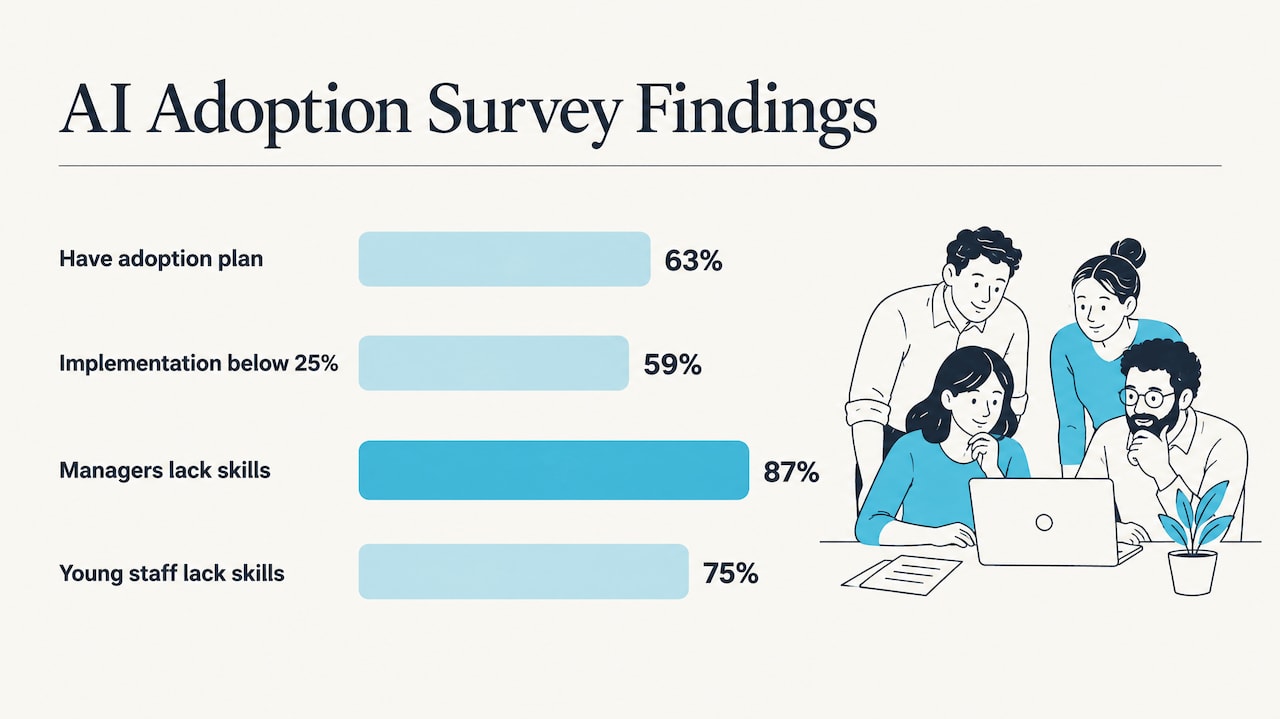
- Most Spanish companies have an AI plan but little to show for it: 63% have a specific adoption plan, yet 59% say implementation is below 25% (IESE, 2025).
- Start with a task people already do every week, not with what the tool can do. A small, visible win beats a company-wide program.
- Involve the people affected early, name champions in each function and train before launch, not after.
- Keep governance light but real: a named owner, a risk review and a log of what the system does. In Spain, workers’ representatives have information rights over algorithms that affect working conditions.
- Measure use and business outcomes together: hours saved, response times, leads handled, errors avoided.
Table of Contents
- Why AI adoption stalls even when the technology works
- Step 1: Choose the work, not the tool
- Step 2: Build support before you build the system
- Step 3: Train before launch, and keep it practical
- Step 4: Governance that does not slow you down
- Step 5: Measure use and outcomes together
- Where we come in
- Our perspective
- FAQ
- Sources
Why AI adoption stalls even when the technology works
The gap between intent and use is well documented. The IESE study cited above found that 63% of surveyed Spanish companies have a specific AI adoption plan, while 59% admit their level of implementation is under 25%. The same study reports that 87% of Spanish companies think their managers lack the skills to lead AI implementation, and 75% say the same about young employees.
The national picture is similar. Spain’s government set a target in its Plan IA360 of raising business AI adoption from 21.1% (INE, first quarter 2025, companies with 10 or more employees) to 55% by 2030. Plenty of companies have tried a chatbot or a copilot. Far fewer have changed how a process runs.
Traditional change management assumes a fixed new process that people must learn once. AI behaves differently in three ways:
- It touches judgment, not just clicks. A sales agent that drafts replies or an invoice system that classifies documents makes decisions people used to make.
- It keeps changing. Models, prompts and data shift, so the process needs an owner after launch, not just a go-live date.
- It raises job-security questions. Staff read an AI project as a statement about their role, whether or not leadership meant one.
A change plan for AI has to handle all three, and it has to be small enough to run alongside the real work.
Step 1: Choose the work, not the tool
The most common mistake is starting with a platform demo. Start instead with a list of recurring tasks and ask where time or revenue leaks.
Good first candidates for a B2B company usually share these traits:
- High volume and repetition: invoices arriving by email, support tickets with similar answers, order requests coming in through messaging apps, lead follow-up.
- Clear inputs and outputs: you can say what goes in, what a correct result looks like, and who checks it.
- A system of record already exists: an ERP, CRM or helpdesk where the result should land.
- A named owner on the business side: someone whose day gets better if it works.
A DigitalES report on AI agents argues that the impact of agents goes beyond one-off savings and can contribute to smoother, more consistent and more adaptable processes. That is the right frame for choosing: you are not hunting for a clever demo, you are looking for a process that should run the same way every time.
For a quick screening, score each candidate from 1 to 5 on volume, rule clarity, data access and owner willingness. Pick the one or two highest. If you want an outside operator to do this screening and ship the result, our AI automation consulting work is built around finding the wins and delivering them.
A worked example
Suppose a 60-person distributor receives 200 supplier invoices a week by email, and two people key them into the ERP. The change plan is not “introduce AI.” It is:
- the two clerks become reviewers of exceptions rather than typists;
- the finance lead owns accuracy targets;
- the first month runs in parallel, with every AI-processed invoice checked;
- the clerks flag error patterns, which feed straight back into the system.
Every person knows what changes for them on day one. That clarity does more for adoption than any town hall.
Step 2: Build support before you build the system
Resistance is usually not stubbornness. It is a reasonable reaction to unclear intent. The guidance available from European bodies points the same direction.
The Ibec guide on AI at work recommends human-centered design with a human in the loop, a change coalition of champions across functions and levels, transparent communication on purpose, benefits and impacts to ease job-security fears, continuous feedback loops, and risk-based training. The Fraunhofer KI-ULTRA guide adds that employees should be involved in designing and implementing AI solutions, so their practical knowledge shapes the result.
In practice, for a mid-sized company, that means:
- Name champions, not a committee. One respected person per affected team who tests early versions and tells colleagues what is real.
- Say what will and will not change. If headcount is not the goal, say so. If roles will shift, say how and when.
- Let users shape the output. The people who handle the invoices know which exceptions break the rules.
- Keep a visible feedback channel. A shared log of issues and decisions works. Tie each entry to the conversation it came from, so the rollout stays honest about what was agreed.
Be straight about jobs
Staff will have read the headlines, so give them the evidence at the right scale. Funcas estimates for Spain a gross loss of 1.7 to 2.3 million jobs over 2025 to 2035 and the creation of 1.61 million new occupations, with complementarity (AI assisting rather than replacing) affecting 2.8 to 3.5 million workers. The same piece cites PwC data showing a 56% wage premium for jobs requiring AI skills, and 14% growth in the most AI-exposed occupations in Spain over 2019 to 2024, against 7% for the least exposed.
The practical reading for a manager: skills matter. Offering people training on the new system is both fair and good business, because the people who learn it first become your internal experts.
Step 3: Train before launch, and keep it practical
Training belongs at the start of the plan even though it appears at the end of the timeline. The Fraunhofer implementation guide recommends preparing employee training well in advance and involving worker representation early in the project.
In the EU there is also a legal angle. Article 4 of the AI Act requires a sufficient level of AI literacy among staff who use AI systems. A Cuatrecasas briefing explains that the article does not prescribe a specific method or test, and lists Commission recommendations: introduction, policies and instructions, roles, risks and benefits, tailored materials and continuous training with follow-up. The briefing itself notes it was overtaken by the 2026 Digital Omnibus, so check the current text of the article with your legal adviser before you document your approach.
A training plan that fits a team of 20 to 200 people:
| Audience | What they need | Format |
|---|---|---|
| Daily users | How the system works, what it gets wrong, how to correct it | Hands-on session on real cases, 60 to 90 minutes |
| Team leads | How to read the metrics, when to escalate | Short briefing plus a weekly check-in |
| Executives | Risks, ownership, decision rights | One-page brief and a review cadence |
| Everyone else | What is changing and why | Short written note and Q&A |
Use your own data in the sessions. People retain a lesson on their own invoice exceptions far better than a generic prompt workshop.
Step 4: Governance that does not slow you down
AI governance does not need a large committee. It needs ownership, a risk view and a record.
The Spanish AI supervisory agency’s risk management guide recommends analyzing the probability and impact of each risk, choosing treatment measures, prioritizing an implementation plan, documenting residual risk and reviewing periodically across the system’s lifecycle, with formal leadership from senior management that publishes a policy, allocates resources and assigns authority and responsibility. The guide also stresses that governance should be scalable and cross-functional, with HR co-leading rather than leaving it to IT alone.
The first pilot of Spain’s AI Sandbox found something worth remembering: according to the official results report, the main challenge was not understanding the obligations of Regulation (EU) 2024/1689 but turning them into internal procedures, documentary evidence and working governance. The effort depended more on the complexity of the AI system and the organization’s maturity than on its size.
For a company your size, that translates into a short checklist per AI system:
- one named business owner and one technical owner;
- a one-page description of what the system does, what data it touches and where a human reviews;
- a log of incidents and changes;
- a review date every quarter.
Workers’ representatives
In Spain, article 64.4.d) of the Workers’ Statute requires informing the legal representation of workers about the use of algorithms or AI that affect decisions on working conditions, access to and retention of employment, including profiling. CCOO’s analysis notes this includes clear information on the logic, variables, weight of each variable and consequences of decisions. If your AI project touches scheduling, performance evaluation or hiring, involve your labor counsel and the works council before launch. The Fraunhofer guide adds that where a fundamental change is needed, an agreement with the works council should be reached.
Step 5: Measure use and outcomes together
Adoption metrics alone flatter you, and outcome metrics alone hide why something failed. Track both, from a baseline taken before launch. How to turn those hours into a number you can defend is in Measuring AI ROI.
| Question | Example metrics |
|---|---|
| Are people using it? | Share of eligible cases handled through the system, weekly active users, override rate |
| Is it accurate? | Error rate on reviewed cases, exceptions per 100 items |
| Is it faster? | Processing time per invoice, first-response time, days to close an order |
| Is it paying off? | Hours returned to the team, leads contacted per week, cost per processed item |
Set a threshold before launch, such as “90% of invoices processed without manual keying within eight weeks,” and review at fixed intervals. The IESE study reports that 73% of Spanish organizations believe AI enables greater flexibility and business adaptation, with the biggest impact in administration and production, which is a useful hint about where to look first. BBVA Research notes that exposed workers may gain productivity through complementarity, especially in skilled and managerial roles whose core tasks are hard to automate. Share results with the team in plain numbers, including what the champions fixed. That is what turns a pilot into the default way of working.
Where we come in
If you want the change plan and the working system delivered together, our AI implementation services cover building production-grade AI for sales, customer service and workflow automation. Projects are led start to finish by senior operators, ship working, measurable software in weeks, and are built on the stack you already run, whether that is an ERP, a CRM or a helpdesk. If the first question is still which process to pick, start with AI consulting.
To see how this looks in a live process, read about our AI workflow automation or how AI customer service is set up to resolve more and escalate less.
Email contact@unlockmanagement.com. We reply within 24 business hours. There is no public rate card.
Our perspective
Most AI change programs we are asked about already have a slide deck. What they lack is a working system that a team can touch.
We think the best change management for AI is a shipped result. When a clerk sees an invoice land in the ERP correctly, or a sales rep sees a qualified reply waiting, the conversation about fear becomes a conversation about what to automate next. That is why the founders lead every project ourselves, and why we scope toward visible, measurable return in weeks rather than months.
We are tech-agnostic and build on the stack a company already uses. That keeps training short, because people stay in tools they know, and it keeps the project inside what the team can actually own afterwards.
Pick one workflow, name the owner, involve the people who do the work, and measure from day one. The rest of the program follows from a first win.
Mario
FAQ
What is the difference between AI change management and normal change management?
Normal change management moves people to a fixed new process. AI changes the tasks themselves, keeps evolving after launch and raises questions about roles. So the plan needs a long-term owner, early involvement of the affected staff and a feedback loop, not only a training day.
How long should an AI adoption project take?
A well-scoped first workflow can be live in weeks, not months, when it runs on your existing systems. What takes longer is the habit: expect a parallel-run period in which people check the output before they trust it.
Do I have to train my staff on AI in Spain?
Article 4 of the EU AI Act requires a sufficient level of AI literacy for people who operate AI systems, without prescribing a method. The rule was reworded by the 2026 Digital Omnibus, so confirm the current wording with your legal adviser and keep a record of the training you give.
Do I need to tell employee representatives about an AI system?
If the system uses algorithms or AI that affect working conditions, access to or retention of employment, article 64.4.d) of the Workers’ Statute requires informing the legal representation of workers. Talk to your labor counsel before launch if the system touches scheduling, evaluation or hiring.
Who should lead AI adoption inside a mid-sized company?
A business owner for each workflow, backed by a senior sponsor and one technical owner. Add champions from the teams affected. Governance guidance recommends formal senior leadership with assigned authority and responsibility, and HR co-leading alongside IT.
Sources
- IESE, El futuro del trabajo: educación, tecnología y competencias (ST-0671)
- Gobierno de España, Plan IA360
- DigitalES, Agentes de IA
- Ibec, Guides to Artificial Intelligence
- Fraunhofer KI-ULTRA, Guide to strategy and change toward the use of AI
- Funcas, Inteligencia artificial y mercado de trabajo en España
- Fraunhofer KI-ULTRA, Guide to the implementation of AI projects
- Cuatrecasas, AI literacy obligation in EU companies
- AESIA, Risk management guide
- Spanish AI Sandbox, results report
- CCOO, La regulación laboral de la gestión algorítmica
- BBVA Research, AI, productivity, employment and growth